

Introduction
I still remember the first time I ruined a perfectly good piece of fabric just because I used the wrong seam. Back then, I didn’t know much about nahttypen, and honestly, I thought a seam was just a seam. Turns out, it isn’t that simple.
Whether you’re sewing at home, working in fashion, or dealing with industrial textiles, nahttypen quietly decide if something lasts for years or falls apart after a few washes. In my experience, understanding seam types is one of those skills that feels boring at first but saves you from countless mistakes later.
Let’s break this down in a practical, human way, without textbook nonsense.
What Nahttypen Really Mean in Practice
Nahttypen aren’t just technical definitions found in sewing manuals. They’re decisions. Every seam answers a question: How strong does this need to be? How visible? How flexible?
In simple terms, nahttypen define:
- How fabric layers are joined
- How stress is distributed
- How clean or decorative the finish looks
From everyday T-shirts to heavy-duty workwear, the seam type often matters more than the fabric itself.
Why Choosing the Right Nahttypen Matters More Than You Think
I’ve seen expensive garments fail because of poor seam choices. And I’ve seen basic cotton shirts last forever because the right nahttypen were used.
Here’s why the choice matters:
- Durability under tension
- Comfort against the skin
- Stretch and movement
- Resistance to washing and wear
A bad seam choice doesn’t show immediately. It shows after time, movement, and washing.
Common Nahttypen Explained (With Real Examples)
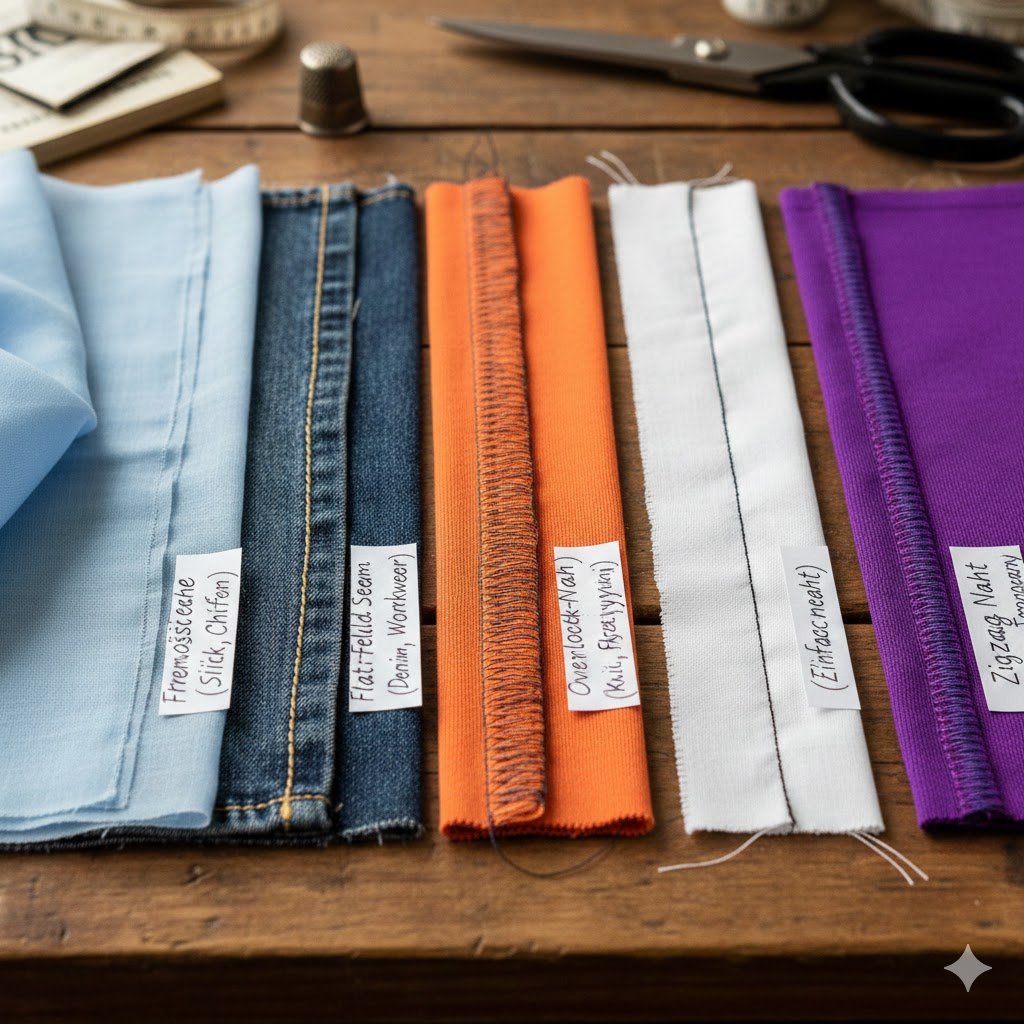
Plain Seam (Einfachnaht)
This is the most basic of all nahttypen. Two fabric pieces are placed right sides together and stitched.
Where it works best:
- Lightweight fabrics
- Interior seams
- Non-stress areas
Pros:
- Quick and easy
- Uses minimal fabric
Cons:
- Frays easily
- Not very strong without finishing
In real life, this seam is fine for prototypes but risky for finished garments.
French Seam (Französische Naht)
This seam hides raw edges completely. I personally love this for delicate fabrics.
Best used for:
- Silk, chiffon, voile
- Transparent materials
Pros:
- Clean interior finish
- Comfortable on skin
Cons:
- Takes more time
- Not ideal for thick fabrics
French seams are one of those nahttypen that feel unnecessary until you wear them.
Flat-Felled Seam (Kappnaht)
This is the seam you see on jeans. It’s tough, visible, and reliable.
Common uses:
- Denim
- Workwear
- Sports clothing
Pros:
- Extremely durable
- Lies flat
Cons:
- More complex
- Adds thickness
If durability is the goal, this nahttypen choice rarely disappoints.
Overlocked Seam (Overlock-Naht)
This seam uses an overlock machine and is common in ready-made clothes.
Used for:
- Knit fabrics
- Fast production
Pros:
- Prevents fraying
- Flexible
Cons:
- Less repair-friendly
- Machine-dependent
This is the backbone of modern clothing production.
Zigzag Seam
A flexible option when stretch matters.
Ideal for:
- Elastic fabrics
- Temporary finishes
Pros:
- Stretch-friendly
- Easy with home machines
Cons:
- Not very clean-looking
- Lower durability
Among nahttypen, this one is more practical than pretty.
Structural vs Decorative Nahttypen
Not all seams are about strength.
Structural Nahttypen
These seams hold the garment together.
Examples:
- Flat-felled seams
- Reinforced plain seams
Decorative Nahttypen
These seams are about design.
Examples:
- Topstitching
- Decorative seams
In practice, the best garments combine both.
How Fabric Type Changes Nahttypen Choice
One mistake beginners make is ignoring fabric behavior.
Lightweight Fabrics
- French seams
- Narrow plain seams
Medium-Weight Fabrics
- Plain seams with finishing
- Overlocked seams
Heavy Fabrics
- Flat-felled seams
- Reinforced seams
The wrong match between fabric and it almost always leads to failure.
Step-by-Step: How to Choose the Right Nahttypen (Practical Guide)
Step 1: Identify Fabric Behavior
Ask yourself:
- Does it stretch?
- Does it fray easily?
Stretch fabrics need flexible seams. Woven fabrics don’t.
Step 2: Consider Stress Points
High-stress areas include:
- Shoulders
- Crotch seams
- Armholes
These areas demand stronger it.
Step 3: Think About Comfort
Interior seams touch skin.
For comfort:
- Avoid bulky seams
- Use enclosed seam types
This matters more than people admit.
Step 4: Decide on Visibility
If the seam is visible:
- Use decorative stitching
- Align with garment style
Invisible seams need clean finishes.
Step 5: Match Skill Level and Tools
Not every seam is beginner-friendly.
Be honest:
- Do you have an overlocker?
- Are you comfortable with multiple passes?
Sometimes the “best” nahttypen isn’t realistic.
Comparison Table: Old vs Modern Nahttypen
| Aspect | Traditional Nahttypen | Modern Nahttypen |
|---|---|---|
| Durability | High with skill | High with machines |
| Speed | Slower | Faster |
| Appearance | Hand-finished | Factory-clean |
| Flexibility | Limited | High |
| Repairability | Easy | Sometimes difficult |
Neither is perfect. It depends on the goal.
Advantages and Limitations of Different Nahttypen
Advantages
- Proper seams extend garment life
- Improve comfort and movement
- Enhance visual quality
Limitations
- Complex seams need practice
- Some require special machines
- Wrong choice wastes time
Every it choice is a trade-off.
Common Mistakes People Make With Nahttypen
I’ve made all of these myself.
- Using plain seams on heavy fabrics
- Ignoring seam finishing
- Prioritizing speed over durability
- Copying factory seams without proper tools
Learning seams is mostly about learning from failure.
Counter-Argument: “Seams Don’t Matter That Much”
I hear this a lot. And yes, for some projects, seams aren’t critical.
But in real use:
- Seams fail before fabric
- Repairs usually start at seams
Ignoring it is like building a house without caring about joints.
Industrial vs Home Sewing Nahttypen
Industrial sewing prioritizes speed and consistency.
Home sewing prioritizes:
- Flexibility
- Repairability
- Custom fit
Neither is better. They solve different problems.
FAQs About Nahttypen
Here are some common questions I hear all the time.
What are the most common nahttypen?
Plain seams, overlocked seams, and flat-felled seams are the most widely used nahttypen.
Which nahttypen are best for beginners?
Plain seams and zigzag seams are beginner-friendly and require minimal tools.
Are overlocked seams stronger than plain seams?
Overlocked seams prevent fraying but aren’t always stronger under tension.
Can one garment use multiple nahttypen?
Yes, and good garments usually do. Different areas need different seam solutions.
Do nahttypen affect garment comfort?
Absolutely. Bulky seams can irritate skin and restrict movement.
How do I know if a seam will last?
Test it. Pull it, stretch it, wash it. Weak seams show themselves quickly.
Conclusion
Understanding it completely changed how I approach sewing and garment quality. Seams are invisible decisions with very visible consequences. When chosen correctly, they disappear into the background and simply work. When chosen poorly, they ruin everything.
In my opinion, learning seam types isn’t optional if you care about durability, comfort, or craftsmanship. It’s one of those unglamorous skills that quietly separates amateur work from professional results.
