

INTRODUCTION
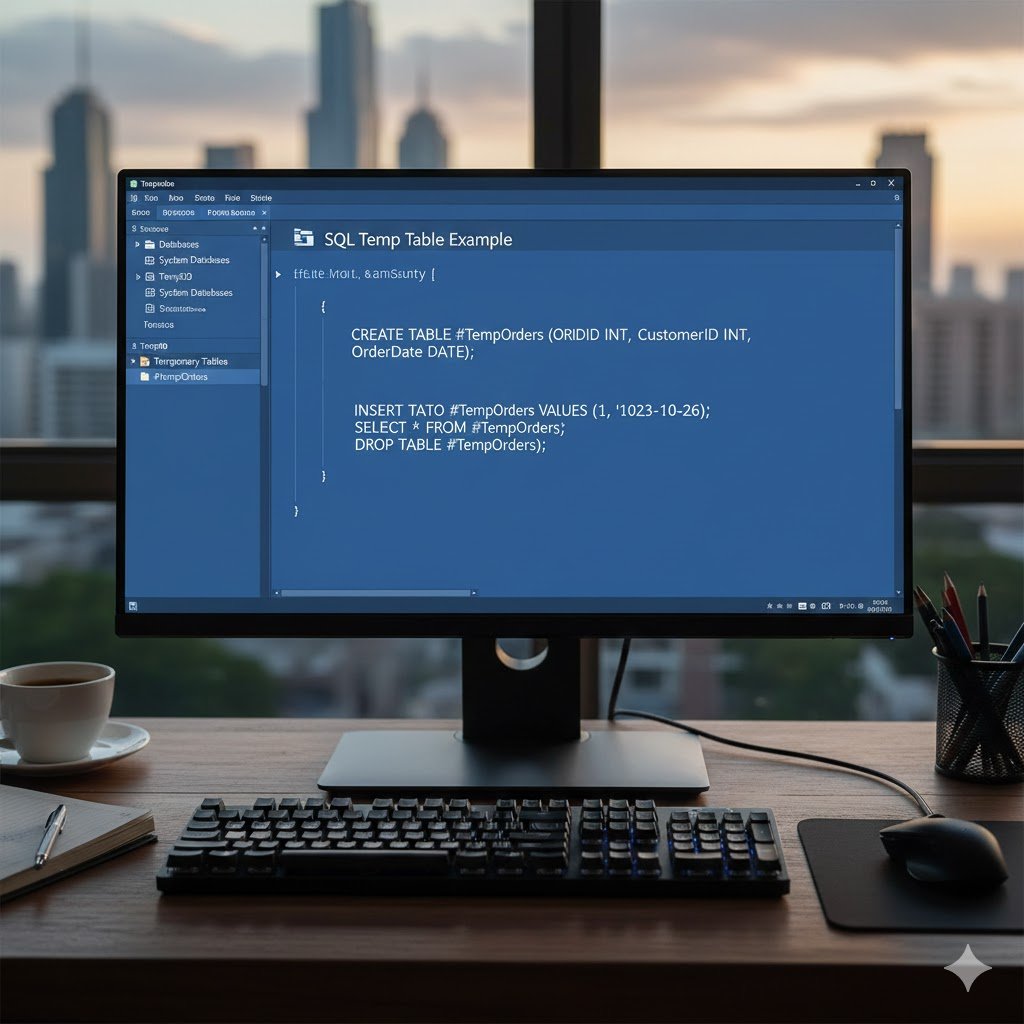
At some point, every database developer hits that wall where queries become too slow, too messy, or too hard to maintain. That’s usually the moment a SQL Temp Table enters the picture.
Temporary tables aren’t just a technical feature; they’re a practical mindset. They help you break complex problems into manageable steps, keep queries readable, and dramatically improve execution time. If you’ve ever struggled with nested subqueries or repeated calculations, understanding how SQL temp tables work can completely change how you write and optimize queries.
What is a Temporary SQL Table?
This temporary nature of the tables makes them suitable for managing data that is transient and does not need to persist beyond the immediate task at hand.
Temporary tables in SQL provide a convenient way to break down complex problems into smaller, more manageable steps. They allow for the separation of data processing stages, which can improve performance, enhance code readability, and simplify query logic.
How to Create a Temporary SQL Table
To create a temporary SQL table, we can use the CREATE TABLE statement with the TEMPORARY or TEMP keyword before the table name. Here’s an example in SQL:
CREATE TEMPORARY TABLE temp_table (
    id INT,
    name VARCHAR(50),
    age INT
);
Code explanation:
- The
CREATE TEMPORARY TABLEstatement is used to create a temporary table. temp_tableYou can choose any name you like.- Inside the parentheses, we define the columns of the temporary table.
- In this example, the temporary table
temp_tablehas three columns:idof type INT,nameof typeVARCHAR(50), andageof typeINT. - We can add more columns as needed, specifying the column name followed by the data type.
SQL Temporary Table Use Cases
Analyzing data subsets using temporary tables
One common use case for temporary tables is analyzing specific subsets of data.
Let’s say we have a large dataset and want to perform complex analysis or calculations on a smaller portion of that data. We can create a temporary table containing only the necessary rows and columns for our analysis. This allows us to focus on a subset of data without modifying the original dataset. Once our analysis is complete, we can drop the temporary table.
For example:
-- Create a temporary table with data subset
CREATE TEMPORARY TABLE subset_data AS
SELECT column1, column2, column3
FROM original_table
WHERE condition;

-- Perform analysis on the subset data
SELECT column1, AVG(column2) AS average_value
FROM subset_data
GROUP BY column1;

-- Drop the temporary table
DROP TABLE subset_data;
Improving query performance with temporary tables
You can use temporary tables to optimize complex or resource-intensive queries. By breaking down a complex query into multiple steps using temporary tables, we can improve query performance by reducing the amount of data processed at each stage or by precomputing intermediate results.
Temporary tables allow us to store and reuse intermediate query results, avoiding redundant computations. Here’s an example:
-- Create a temporary table to store intermediate results
CREATE TEMPORARY TABLE temp_results AS
SELECT column1, COUNT(*) AS count_value
FROM large_table
WHERE condition1
GROUP BY column1;

-- Use the temporary table to optimize the final query
SELECT column1, column2
FROM temp_results
WHERE count_value > 10
ORDER BY column1;

-- Drop the temporary table
DROP TABLE temp_results;
Staging and transforming data using temporary tables
SQL Temp Table are also useful for staging and transforming data before loading it into permanent tables. We can create a temporary table, import data from different sources, perform data cleansing, apply transformations, and validate the data before inserting it into the final destination.
Temporary tables provide a flexible and efficient way to process and manipulate data without affecting the original source. Here’s an example:
-- Create a temporary table for staging data
CREATE TEMPORARY TABLE staging_table (
    id INT,
    name VARCHAR(50),
    quantity INT
);

-- Import and transform data into the staging table
INSERT INTO staging_table (id, name, quantity)
SELECT id, UPPER(name), quantity * 2
FROM external_source;

-- Validate and manipulate data in the staging table
UPDATE staging_table
SET quantity = 0
WHERE quantity < 0;

-- Insert transformed data into the final table
INSERT INTO final_table (id, name, quantity)
SELECT id, name, quantity
FROM staging_table;

-- Drop the temporary table
DROP TABLE staging_table;
Differences between Temporary and Permanent Tables in SQL
| Criteria | Temporary Tables | Permanent Tables |
| Lifespan | Exist only for the current session or connection | Persist even after the session or connection is closed. |
| Data persistence | Data is not persisted beyond the current session | Data is persisted permanently |
| Storage allocation | Temporary storage is typically allocated in memory or temporary storage space | Permanent storage is allocated on disk or in a database. |
| Accessibility | Accessible only to the session or connection that created it | Accessible to all users and connections with appropriate privileges. |
| Naming convention | Temporary table names are often prefixed with a special character or keyword | Permanent table names are not prefixed with any special character or keyword. |
| Data retention | Data is automatically deleted at the end of the session or connection | Data remains in the table until explicitly deleted or modified. |
| Indexes and constraints | Temporary tables can have indexes and constraints, but they are typically temporary and are dropped when the table is dropped | Permanent tables can have indexes, constraints, and triggers. |
| Transactional properties | Temporary tables are often not transactional by default, but this can vary depending on the database system | Permanent tables participate in transactions and support ACID properties. |
Conclusion
SQL Temp Table are a valuable tool in the world of database management and query optimization. They offer various benefits and can significantly enhance your SQL experience.
Through practice and experimentation, you can uncover innovative ways to leverage temporary tables and enhance your SQL skills.
