

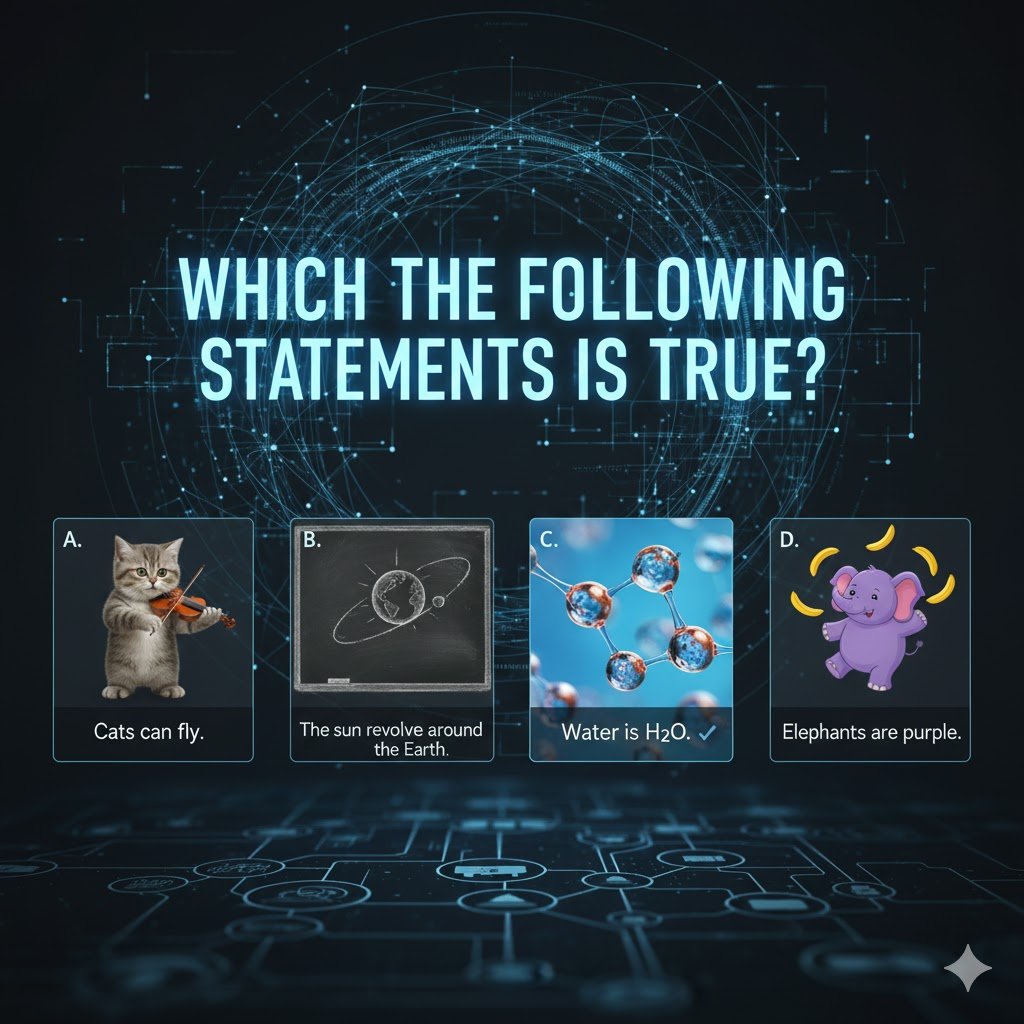
Featured Snippet: What Is “Which of the Following Statements Is True?”
“Which of the following statements is true?” is a question format used to test understanding, logic, or accuracy by presenting multiple statements and asking you to identify the single correct one based on facts, rules, or reasoning.
Introduction: Why This Question Trips Up So Many People
If you’ve ever stared at a multiple-choice question and thought, “At least two of these look right,” you’re not alone.
The phrase which of the following statements is true? shows up everywhere—school exams, competitive tests, interviews, certifications, even online quizzes.
And yet, it consistently causes confusion.
Not because the topic is hard.
But because the wording is designed to test precision, not memory.
I’ve seen smart people lose points not because they didn’t know the material, but because they misunderstood what “true” actually meant in that context.
This guide breaks it down clearly, practically, and honestly—so you can stop guessing and start answering with confidence.
What “Which of the Following Statements Is True?” Really Means
This question is not asking what sounds right.
It’s asking what is completely accurate under the rules of the question.
That distinction matters.
Key Characteristics of This Question Type
When you see which of the following statements is true, you should immediately assume:
- Only one option is fully correct
- Other options may be:
- Partially true
- True in some situations
- Logically appealing but factually wrong
- Precision matters more than general understanding
This question rewards careful reading, not speed.
Why Exam Writers Love This Question Format
There’s a reason this format is everywhere.
It exposes how people think.
What It Actually Tests
- Attention to detail
- Logical reasoning
- Ability to detect absolute vs conditional claims
- Understanding of definitions, not assumptions
In other words, it separates confidence from correctness.
Common Traps Hidden in These Questions
Most wrong answers aren’t random.
They’re carefully designed distractions.
Trap 1: “Almost True” Statements
These are the most dangerous.
They’re correct except for one small flaw.
Examples:
- Wrong time frame
- Incorrect condition
- Overgeneralization
If even one part is wrong, the whole statement is false.
Trap 2: Absolute Language
Words like:
- Always
- Never
- All
- None
These are red flags.
Absolute claims are rarely true unless the subject is mathematical or definitional.
Trap 3: Emotional or Familiar Phrasing
Some options sound right because you’ve heard them before.
That doesn’t make them true.
Familiarity isn’t accuracy.
How Truth Is Defined in These Questions
Truth here doesn’t mean “mostly correct.”
It means:
- Factually accurate
- Logically consistent
- Fully aligned with the question’s scope
No exceptions.
No assumptions.
No personal interpretation
Step-by-Step Method to Find the True Statement
This is the process that consistently works.
Step 1: Read the Question Twice
Not the answers.
The question.
Ask yourself:
- What topic is being tested?
- What rules or assumptions are given?
Miss this, and everything else falls apart.
Step 2: Eliminate Clearly False Options
Don’t hunt for the right answer immediately.
First, remove:
- Statements that contradict known facts
- Options outside the scope of the question
- Claims with obvious exaggerations
This reduces noise fast.
Step 3: Test Each Remaining Statement Independently
Pretend each option exists alone.
Ask:
- Is this always true?
- Can I think of even one valid exception?
One exception = false.
Step 4: Compare Precision, Not Length
The longest answer is not always correct.
The shortest answer is not always correct.
The most precise answer usually is.
Step 5: Re-read the Question One Final Time
Before locking in your choice, verify:
- Does this statement answer exactly what’s being asked?
- Not more.
- Not less.
Real-World Example
Imagine the question:
Which of the following statements is true about online privacy?
Options:
- Online privacy no longer exists
- Using a VPN guarantees total anonymity
- Strong passwords reduce security risks
- All websites collect personal data
Only one is fully accurate.
- Option 1 is exaggerated
- Option 2 is absolute and false
- Option 4 is too broad
Option 3 is true without exceptions.
That’s how these questions work.
Why Partial Truth Is Still False
This is where most people struggle.
A statement can be:
- 90% correct
- Widely believed
- Supported by examples
And still be wrong.
These questions don’t reward “close enough.”
They reward complete accuracy.
How Context Changes What’s True
Truth depends on boundaries.
Pay Attention To
- Time period
- Conditions
- Definitions used in the question
- Assumed knowledge level
A statement can be true in one context and false in another.
Only the context given matters.
How-To Guide: Answering These Questions With Confidence
Here’s a practical system you can apply immediately.
Step 1: Highlight Keywords
Mentally underline:
- True
- Always
- Except
- Most likely
- Best
These words control meaning.
Step 2: Translate Each Option Into Plain English
If you can’t explain it simply, you don’t fully understand it.
Confusion often hides errors.
Step 3: Actively Look for Reasons It’s False
Don’t ask why it’s right.
Ask why it might be wrong.
This flips your mindset and exposes flaws faster.
Step 4: Trust Logic Over Instinct
Instinct reacts.
Logic verifies.
When they conflict, logic wins.
Comparison Table: True vs Tempting but False Statements
| Feature | Truly Correct Statement | Tempting but False Statement |
|---|---|---|
| Accuracy | Fully accurate | Partially accurate |
| Language | Precise | Vague or absolute |
| Exceptions | None | At least one |
| Emotional appeal | Neutral | Sounds confident |
| Exam safety | Safe | Risky |
Why This Skill Matters Beyond Exams
This isn’t just about tests.
This skill improves:
- Decision-making
- Critical thinking
- Media literacy
- Professional judgment
Being able to identify what’s truly correct in a list of claims is a life skill.
Frequently Asked Questions
Below are common questions people ask when they encounter which of the following statements is true?
Which of the following statements is true if more than one seems correct?
Only one is completely correct. The others contain subtle flaws, exceptions, or inaccuracies.
Is a partially true statement ever the correct answer?
No. If any part of a statement is false, the entire statement is false.
Why do exam questions use tricky wording?
To test understanding, not memorization. Precision reveals real comprehension.
Should I choose the most detailed option?
Not automatically. Choose the most accurate and precise option, regardless of length.
Can absolute statements ever be correct?
Yes, but rarely. They must be true without exception.
How can I get better at answering these questions?
Practice slow reading, eliminate wrong options first, and always test for exceptions.
Conclusion: The Truth About “Which of the Following Statements Is True?”
At its core, which of the following statements is true? is a test of clarity.
Not intelligence.
Not confidence.
Clarity.
The correct answer is the one that survives scrutiny, exceptions, and logic—without leaning on assumptions or emotional appeal.
Once you train yourself to look for complete accuracy instead of familiar phrasing, these questions stop being intimidating and start becoming predictable.
